9 Hydrangea Growing Tips for Your Garden
Beautiful hydrangeas continue to dominate perennial gardens for good reason. These reliable bloomers are must-haves, no matter your garden size or style. Gardening expert Madison Moulton lists 9 tips for hydrangea growing success.


Contents
Hydrangeas are one of the most popular flowering perennials. They look stunning on their own, at the back of perennial beds, or even planted en masse as a hedge. Gardeners (and particularly cut flower gardeners) look forward to the continuous blooms throughout the summer season.
Hydrangeas are not difficult to grow, but there are a few tips to be aware of to keep them looking their best. You don’t want to use the wrong fertilizer or prune at the wrong time, only to end up with sticks at the end of the season and no flowers.
These hydrangea growing tips will ensure these shrubs look their best, from choosing your varieties to getting them in the ground and taking care of them.


Choose the Right Variety

There are several hydrangea species to choose from, and the one you select will depend not only on the look you want but also on your climate and growing conditions. Not all hydrangeas are created equal, and picking the right one will give these shrubs a better start in your garden.
To grow hydrangea successfully, start by considering your climate. Those in cooler zones are better off with smooth or panicle hydrangeas, as these are generally more cold-tolerant. Warmer zones can grow the popular bigleaf hydrangeas or oakleaf hydrangeas.
There are also other species to choose from, and within that, different cultivars. Check the varieties and the details of the specific ones you plan to grow to ensure they’re suitable for your zone.
When it comes to colors and characteristics, you have an almost endless choice. ‘Endless Summer’ hydrangeas (Hydrangea macrophylla) are one of the most popular options known for their long blooming period. If you’re planning on planting in containers, something like ‘Cherry-Go-Round‘ would be a great choice. If you want unique color and stunning cut flowers all summer, try a panicle hydrangea like ‘Vanilla Strawberry.’ If you prefer species native to North America, look for smooth hydrangeas, oakleaf hydrangeas, or evergreen climbing hydrangeas.
Ultimately, it’s more important to choose a hydrangea that fits your climate and location over the look you desire. There’s so much variety within each species that you’re bound to find something you love.
Prepare Your Soil

As with any shrub, preparing your soil before planting is essential to the health of the plant. Choosing the wrong soil can impact the roots and early growth, meaning you might have to move them later. Or worse, the plant might die before it gets a chance to flower.
Like many perennials, hydrangeas love well-draining, fertile soil. Heavy clay is not recommended, as it can suffocate the roots, leading to issues with fungal disease.
Whether your soil has too much clay or too much sand, the fix is easy: add plenty of compost. Adding organic matter to the soil improves structure over time and encourages beneficial microbes, boosting overall soil health.
A few weeks before you plant your hydrangeas, add compost or other organic matter into the soil and mix it well. After mixing, water the area and allow the compost to work its magic.
To grow hydrangea in containers, choose high-quality potting soil and add extra moisture retention and drainage materials like coconut coir and perlite. This will improve drainage in the soil (which is particularly important in shady areas) while retaining enough moisture to keep the roots satisfied.
Choose Large Containers
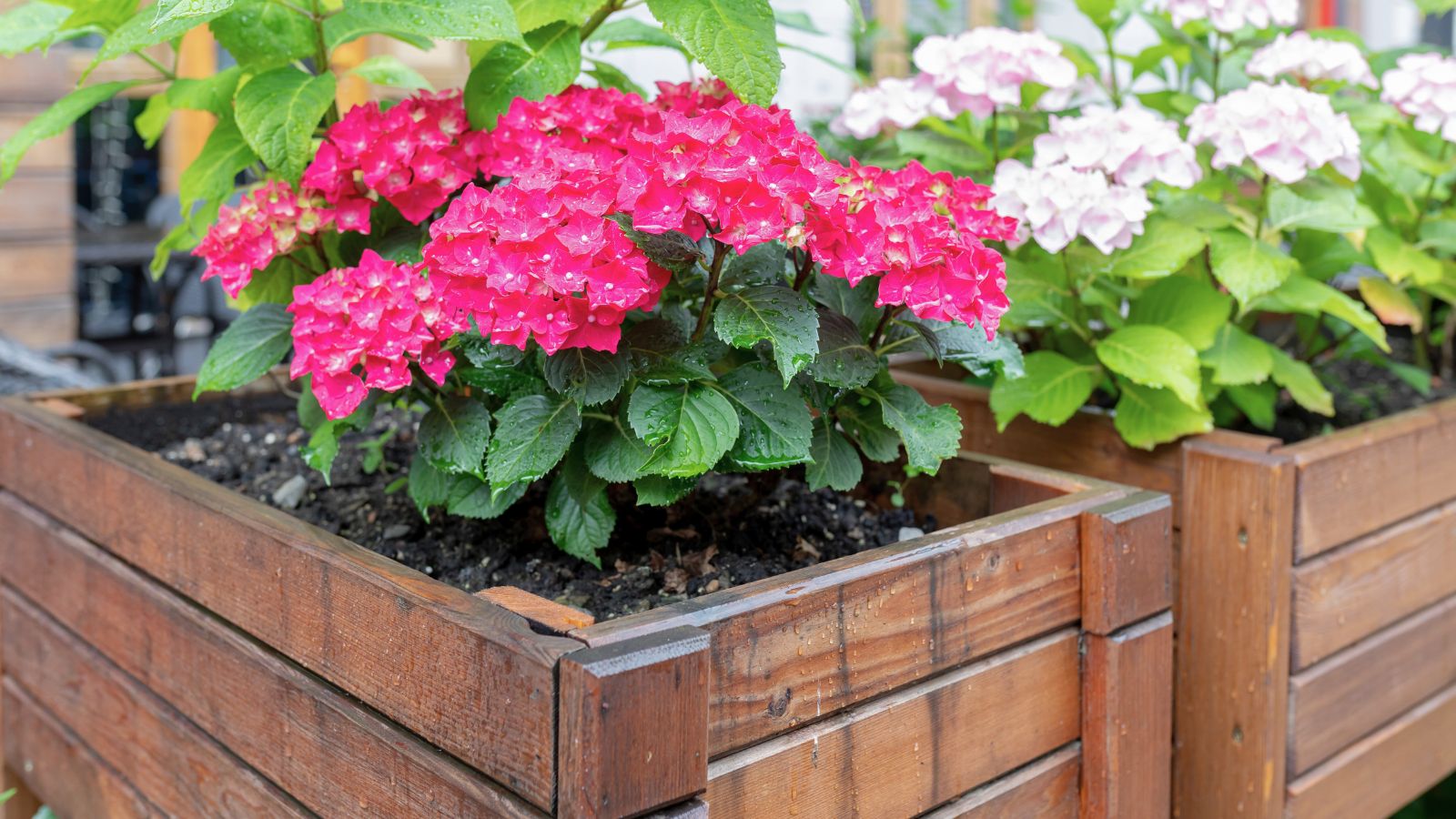
It’s possible to plant compact hydrangea varieties in pots rather than in the ground, which is great for decorating patios, or container gardens with limited space. Due to the size of the root systems and the shrub overall, choose a large container or raised bed that won’t restrict the growth of your chosen variety.
Pick a container that is deep and wide enough to accommodate the size of the mature shrub. You also don’t want it to become too top-heavy. Generally, the plant should never be more than double the size of the container. As always, make sure the container you choose has drainage holes at the bottom to prevent waterlogging and root rot.
Once you’ve picked a container, check that the species you’re growing is small enough to thrive in pots. ‘Cherry Go Round’ is a great choice, as this hydrangea doesn’t grow too large.
Time Your Planting Carefully

A strong root system starts with planting at the right time. Planting in cool and mild conditions will allow your hydrangea to focus on establishing in the soil, creating a good foundation for later growth and flowering.
You can plant in fall or spring, and the time you choose depends on your climate and the variety you’re growing. Fall is an ideal time because it gives the shrub time to establish roots before the cold sets in. However, if you live in an area with very cold winters or you’re growing a cold-tender species like bigleaf hydrangeas, it may be better to wait until spring to avoid any early damage.
You can technically plant from spring through to fall. However, it’s best not to plant in summer when conditions are too hot and the soil dries out quickly, as this can impact root development.
Water Consistently

Hydrangeas love moisture. Soon after planting, they will need plenty of water to establish strong roots. Deep watering encourages the roots to grow downwards into the soil. Shallow watering will limit access to water later on, which is especially important around flowering time.
In summer, they will also need regular watering to combat dry soil and promote strong flowering. Some species are more drought-tolerant than others, but all will perform far better with a regular watering schedule.
If needed, you can always install drip irrigation to make watering simpler. This also limits issues with overhead watering that can lead to fungal diseases.
The caution with this tip is that you should never overdo it. Make sure your soil drains well enough to prevent moisture from pooling around the roots. This limits oxygen flow and can lead to fungal diseases like root rot.
Feed As Needed

Hydrangeas are generally not considered heavy feeders, especially in the case of more tolerant species like oakleaf hydrangeas. Most native species do not require much feeding. However, if you want an explosion of blooms in summer, fertilizing is recommended.
This does not have to mean using a hydrangea-specific fertilizer often from spring to fall. It could be as simple as applying a layer of compost as mulch and replenishing it as it breaks down to improve soil health.
The best way to determine what your hydrangeas need is with a soil test. A soil test will tell you the pH, the nutrients in your soil, and the organic matter content, allowing you to adjust as necessary to grow hydrangea. Once you know which nutrients your soil is deficient in or what there is too much of, you can choose an organic fertilizer that matches your needs.
Be wary of applying fertilizers with too much nitrogen, as this will encourage leaf growth over flowers. A boost of nitrogen is fine in the early stages to encourage leaf and stem growth, but avoid using high-nitrogen fertilizers in summer during flowering time.
Prune at the Right Time

Pruning hydrangeas is a little more complex than other shrubs due to the differences between species. Some varieties bloom on old wood, while others bloom on new wood. If you prune varieties that bloom on old wood at the wrong time, you will be cutting off the flower buds for the next season. In other words, you’ll only end up with leaves.
Big leaf, mountain, and climbing hydrangeas all produce flowers on old wood. Old wood hydrangeas should be pruned as quickly after blooming as possible. At the end of the season, you can conduct your pruning while deadheading, making sure you’re not trimming off any newly produced flower buds. If you’re happy with the shape, you may not need to prune them at all.
Panicle and smooth hydrangeas bloom on new wood and only produce flower buds in spring. Pruning of these varieties can be done after blooming, including in the fall. Make sure you prune these by late winter, as flower buds may start emerging once the weather warms.
Watch for Frost

At the end of the season, once flowering is done and frost looms, protect your sensitive hydrangeas from frost. Bigleaf, oakleaf, evergreen climbing, and mountain hydrangeas are all frost-sensitive and may not bloom the next year if the flower buds die off.
To protect them from frost, keep tender ones warm by adding mulch around the base. If you are in a particularly cold zone, you may be better off sticking to hardier species like panicle and smooth hydrangeas.
Know How to Change Flower Colors

Changing flower colors is one of the most exciting events when you grow a hydrangea. However, not all hydrangeas can change colors.
Bigleaf and mountain hydrangeas are the two species that change flower colors based on how much aluminum they access. If your soil is more acidic, the flowers will turn blue, and if your soil is more alkaline, the flowers will turn pink. The color change is not about pH levels specifically, but how the pH level impacts aluminum access to the plants.
It is possible to use organic amendments to change the colors of certain hydrangeas. Examples include adding phosphorus for pink flowers or sulfur or compost for blue flowers. These amendments need to be made before flowering to ensure the soil is right by the time summer comes.
While these amendments will not negatively impact other hydrangeas, you do not want to get stuck in the cycle of amending your soil to try to change a flower color that will never change. Make sure you grow a hydrangea that can change color before amending the soil to avoid causing any imbalances that will negatively impact growth over time.


